
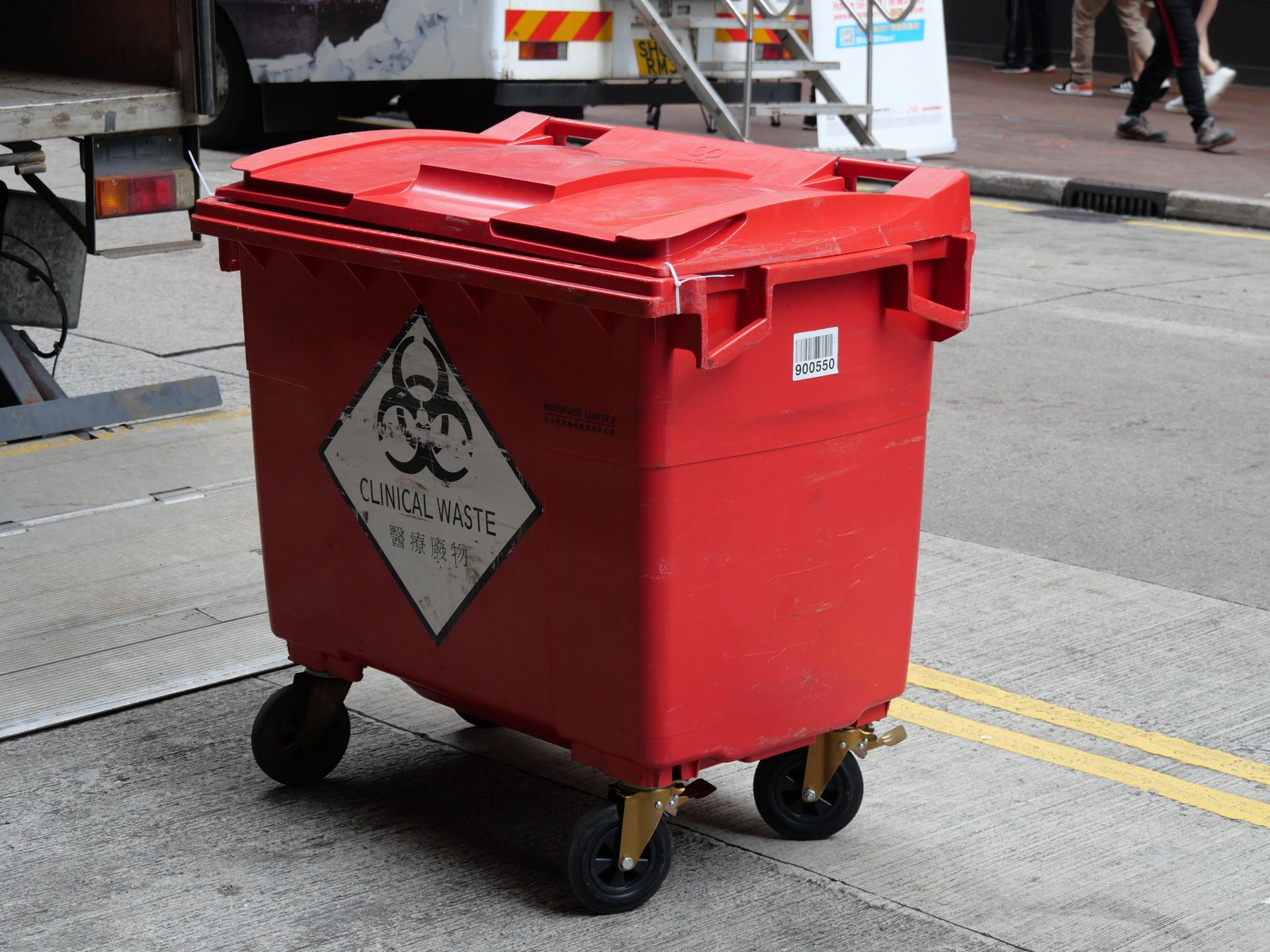
Why Can’t Sharps Go in the Regular Trash?
Takeaways: Sharps can’t go into regular trash bags for one simple reason: the needles
#1 Online Store to Buy OSHA/CDC Compliant Sharps Containers and Cabinets
Free Shipping on Any Order of $1000 or More
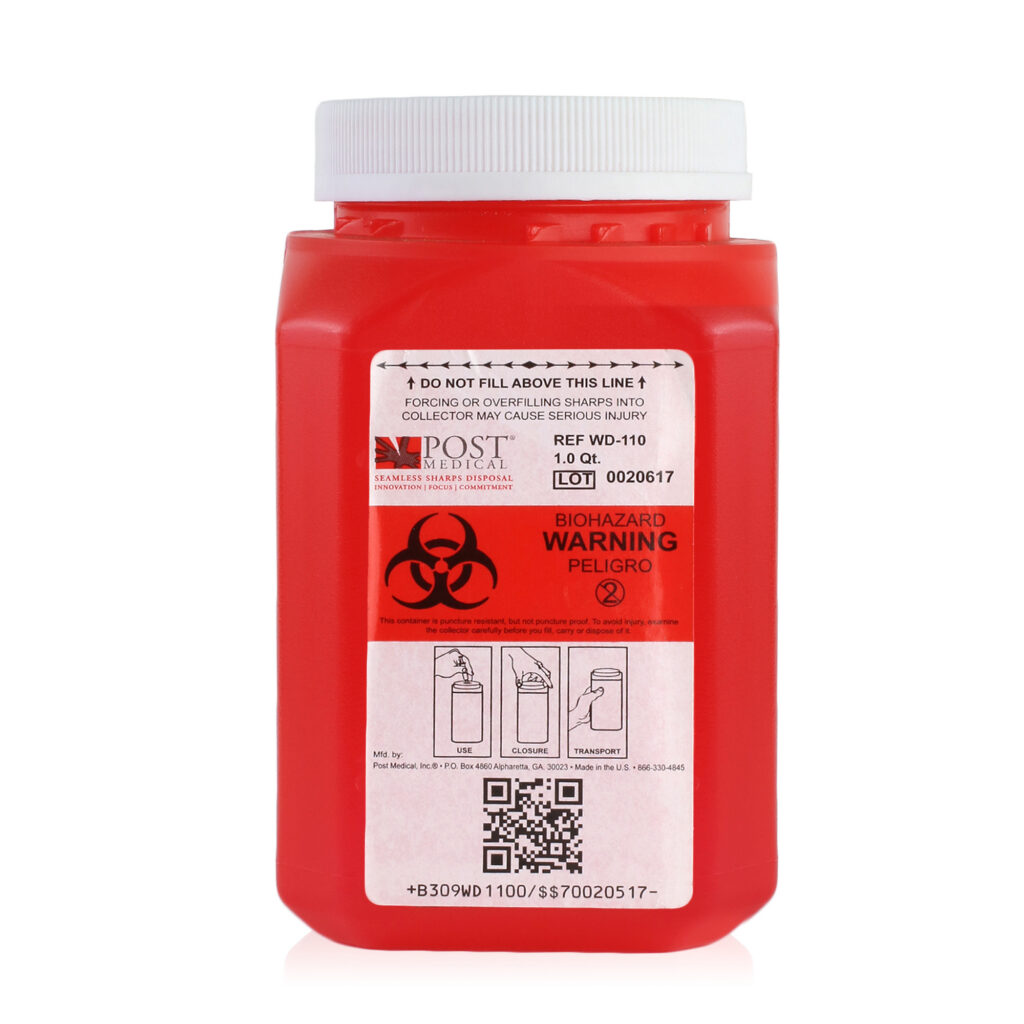
A used needle does not stop being dangerous once the injection is over. It stays hazardous through every step that follows, including the trash bag, the collection truck, and the sorting facility. That chain of risk is the reason sharps have their own federal rules, their own disposal hardware, and their own vocabulary.
If you have just been prescribed an injectable medication or are setting up a new clinic room, this guide covers the basics. Start with the object that does most of the work.
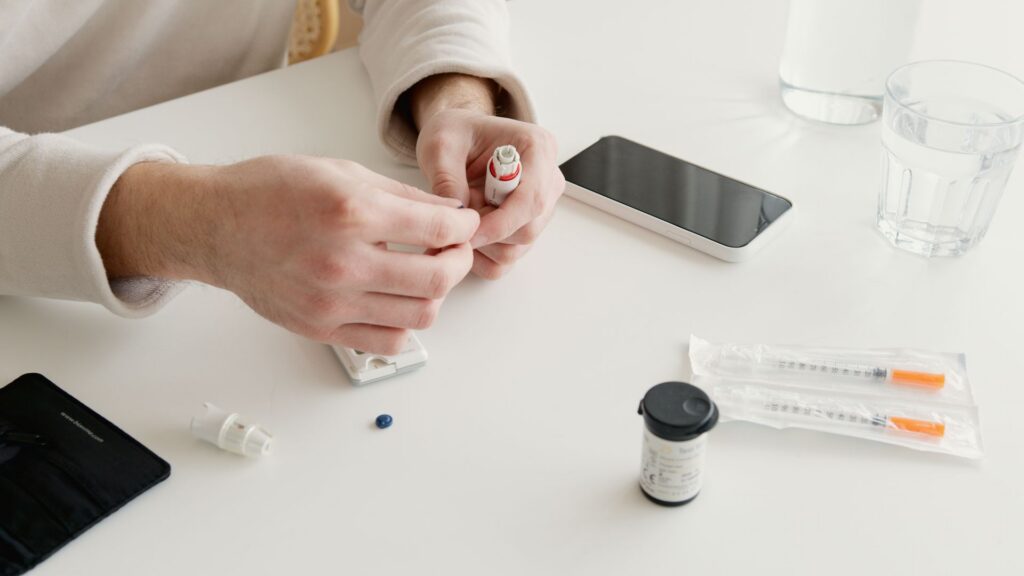
The category is broader than most people expect. Needles and syringes are the obvious members, but lancets, scalpel blades, suture needles, infusion sets, and auto-injector pens all qualify.
The working definition is any device sharp enough to puncture skin that has contacted blood or another potentially infectious material. Broken glass from a specimen vial counts. So does the tiny lancet from a home glucose test, which people discard casually far more often than they should. Which raises the obvious follow-up. What is a sharps container, and why will ordinary trash not do?
So what is a sharps container, in practical terms? It is a rigid, puncture-resistant vessel built to accept used sharps one way and never let them back out.
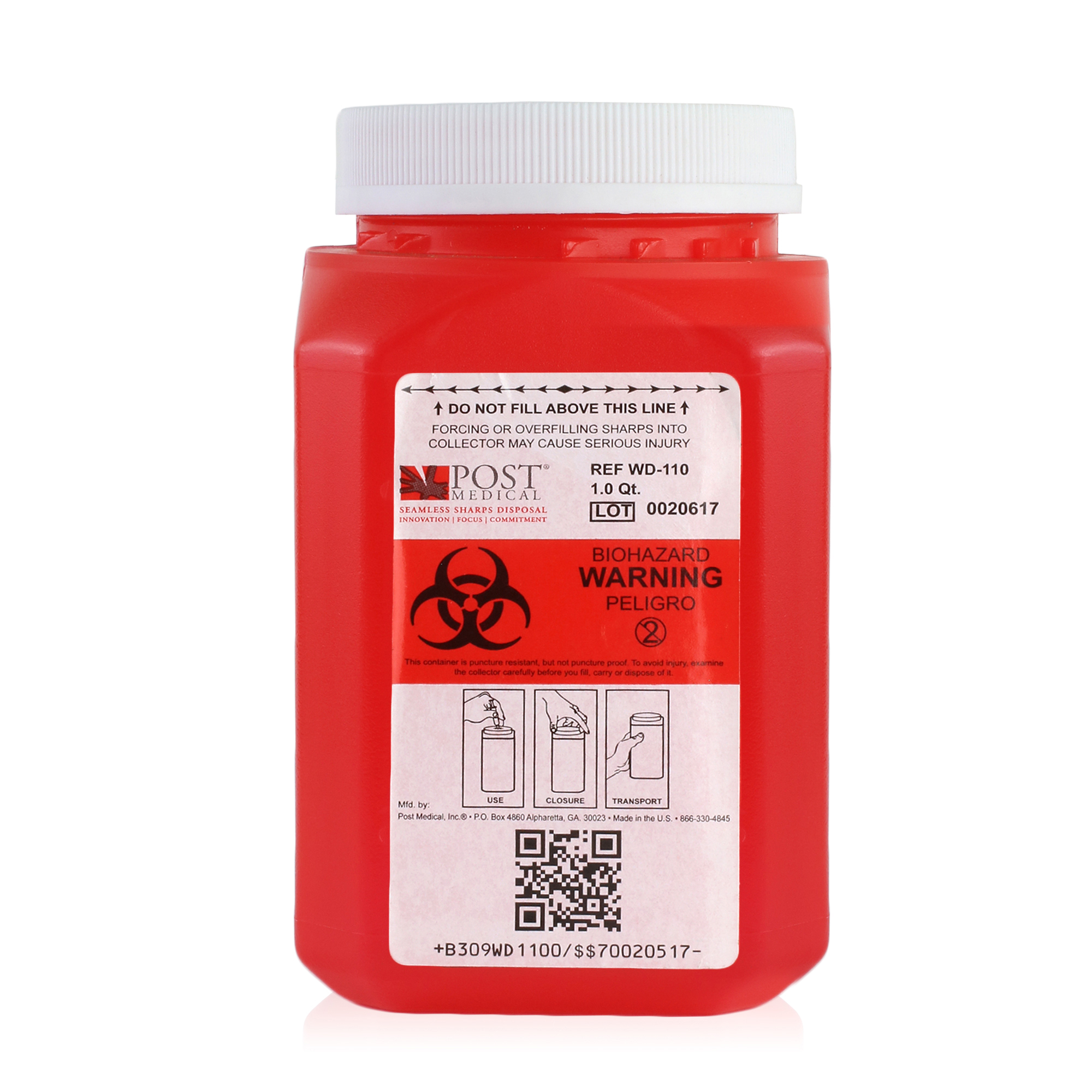
Most are molded from high-density polyethylene with thick walls, leak-resistant seams, and a lid that either snaps shut temporarily or locks permanently. The bright color and biohazard symbol are not decoration. They tell every person downstream what is inside before anyone opens anything.
Anyone asking what a sharps container is made of should know the material choice is deliberate. Rigid plastic resists a needle driven at it from the inside, which a cardboard box or laundry detergent jug will not do.
A needlestick can transmit hepatitis B, hepatitis C, and HIV. The injury itself is usually minor, which is exactly what makes people underreport it and skip the follow-up testing that matters.
Most exposures happen during disposal rather than during treatment. Recapping, reaching into an overfull bin, and carrying an uncapped needle across a room are the recurring culprits, and understanding how these injuries happen across different work settings is the first real step toward preventing them.
Sanitation workers and the public absorb the rest of the risk. A needle in a curbside bag can reach a stranger’s hand weeks after anyone thought about it.
The agency treats these containers as Class II medical devices, which means a manufacturer needs clearance before selling one. FDA sharps disposal standards call for heavy-duty construction, a tight-fitting puncture-resistant lid, leak resistance, stability while upright, and clear hazard labeling.
Clearance numbers are worth checking before you buy. Post Medical publishes its own in the answers to its most common product questions, alongside the exact regulatory language behind each design decision.
Fill lines come from the same rulebook. FDA sharps disposal guidance puts that line roughly three-quarters of the way up, well below the rim, so nothing protrudes when the lid closes.
That threshold is not conservative padding. It reserves the room a lid needs to seat fully and keeps hands clear of the needles inside.
Employers answer to a second authority. The Bloodborne Pathogens Standard at 29 CFR 1910.1030 requires that any workplace with anticipated exposure treat containers as engineering controls rather than supplies.
The sharps container requirements in that standard are specific. Contaminated sharps go in immediately or as soon as feasible, containers stay upright throughout use, and they get replaced routinely rather than topped off.
Placement carries equal weight. Containers must sit as close as feasible to where sharps are actually used, because distance is what tempts someone to walk with an exposed needle. Post Medical keeps the federal and state citations it designs against on file for buyers who need them.
Two models exist. Single-use containers are sealed and destroyed with their contents, while reusable ones are emptied by a service, robotically washed, and returned to circulation.
Reusables carry a higher bar. FDA sharps disposal policy requires them to be cleared specifically as reusable devices, permanently marked as such, and disinfected according to what they previously held.
High-volume facilities often prefer the service model for cost and waste reduction. Home users almost never do.
By this point, the question is rarely what a sharps container is. It is which size and mount belong in which room.
Volume drives the first decision. A quart-sized unit suits a home user injecting daily, while a phlebotomy draw station or surgical suite burns through capacity fast enough to need gallons.
Clearance narrows the field before either. FDA sharps disposal standards give you a shortlist of legitimate manufacturers and quietly eliminate the rest.
Mounting drives the second. Wall-mounted steel cabinets that lock a container in place prevent tipping and deter tampering, which matters in a corrections facility or a public restroom far more than it does in a private exam room.
Blades deserve their own hardware. Scalpel and surgical blades move through dedicated blade disposal units and brackets designed for single-handed removal.
The answer to what a sharps container is does not change by setting. The size, the mount, and the security level all do.
A veterinary clinic, a blood bank, and an ambulance all generate sharps under different constraints. Post Medical breaks its guidance down by the environments it builds for, from surgery centers to prison facilities.
Front-of-house placement adds a wrinkle. Tabletop containers in a patient-facing room can look clinical or alarming, which is why covers that conceal quart-sized containers exist for offices where appearance matters.
Public buildings face a harder problem. Businesses and municipalities increasingly find that planning for sharps in restrooms and lobbies beats discovering them the hard way.
Facilities rarely wonder what to do with sharps containers, because a hauler contract settles it. Home users get no such default.
Stop at the fill line. Close the lid permanently, confirm the seal, and never press down on the contents to buy room.
From there, the answer depends on who you are. Facilities schedule pickup with a licensed medical waste hauler, while home users have narrower options and more confusion about what to do with sharps containers once they are sealed.
Household routes vary widely by state. Drop-off sites, mail-back programs, and hospital collection points are the usual three, and public collection bins have expanded in many communities to close the gap.
One rule holds everywhere. A sealed container never belongs in curbside recycling, and anyone unsure what to do with sharps containers should call their county health department before guessing.
Pharmacies are worth asking too. Some accept sealed containers directly, and others sell mail-back kits covering postage and destruction.
At-home injection has grown quickly, and the surge in GLP-1 prescriptions has put needles in millions of households that never handled them before. Many of those users improvise a container, which is where the trouble starts. FDA sharps disposal rules cover household products as fully as clinical ones.
Storage matters as much as the container. Keeping one upright, closed, and out of a child’s reach removes the most likely path to an accidental stick.
Caregivers should learn what to do with sharps containers before the first one fills. Waiting until it does tends to produce a jar on a shelf that nobody wants to move.
Knowing what is a sharps container approved for home use saves a call later. A cleared quart or two-quart unit costs little and travels well for anyone injecting away from home.
Container design keeps moving. Touchless drop tubes, tamper-resistant closures, and fill sensors have all arrived in response to injuries that older hardware allowed, and recent advances in disposal management show how quickly the category is changing.
Materials have improved alongside them. Thick-wall polyethylene and heavy-gauge steel now do work that thin plastic once failed at.
Start with volume, then placement, then the fill-line habit. Those three decisions cover most of what a beginner needs, and what a sharps container is becomes less of an abstract question the moment one is mounted on your wall.
Buy cleared hardware rather than improvising. Anything that meets FDA sharps disposal standards will display its clearance openly, and anything that does not is telling you something.
Post Medical has manufactured this equipment in the United States since 1982. You can browse its full range of cleared containers or the complete catalog of disposal hardware to match a room, a route, or a routine.
Settle what to do with sharps containers before you buy one. Check your state rules by visiting www.safeneedledisposal.org for disposal sites near you. Medical waste law varies, and the answer that works in Georgia may not apply where you practice. Post Medical can point you toward the right configuration if you are unsure.

Takeaways: Sharps can’t go into regular trash bags for one simple reason: the needles
Key Takeaways A used needle does not stop being dangerous once the injection is

The safest way to store a sharps container in a home with children is